
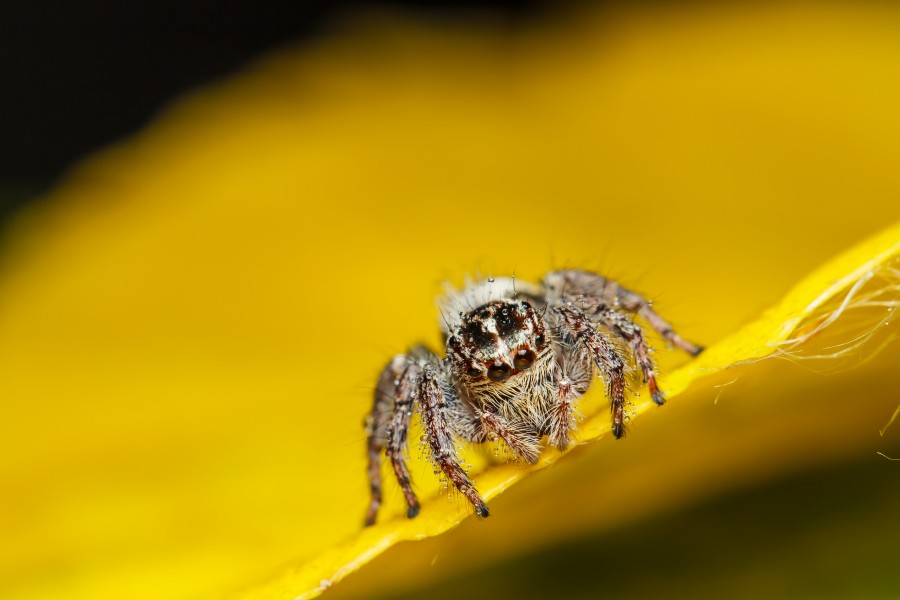
It’s spider season! And no, not just for the purpose of Halloween decor as families trick-or-treat their way through your neighborhood. It’s a commonly held belief more spiders are entering our homes as we enter the fall season; however, these guests aren’t arriving to keep their (eight) feet warm.
Rather, the majority of spiders migrating to our homes in the fall are in search of a mate. Spider mating season of many species coincides with the transition of summer into fall, and male spiders wander long distances to find a partner. Females usually remain hidden in crawlspaces, storage areas, wall and floor voids and behind furniture and appliances. An estimated fewer than 5% of the spiders you find indoors have actually ever been outdoors – “house spiders” generally spend their entire lifecycle indoors as they are not adapted to tolerate the outdoors.
Garden spiders are also more active in the fall for the same reason, it’s mating season; however, these spiders are adapted to outdoor living and the females spin enormous webs (up to two feet in diameter!) and settle in the center, waiting for a male suitor. While the webs and, arguably, the spiders are beautiful, they can be inconveniently located and we likely all have crashed through a giant web. The spiders are resilient, and will simply rebuild in the same place unless they are manually relocated somewhere less obstructive.
While very few spiders are harmful to humans, two exceptions are the brown recluse spider and the black widow spider. The brown recluse is drawn to clutter and/or darkness in the under-used areas of our homes such as shoes, clothing, bedding and decorations. The injection of its bite can create a blister than may develop into an open wound requiring months to heal. While this spider’s natural territory is limited to the southern and central Midwestern states, bites have been filed from as far away as Alaska. The black widow is typically found in wood piles, on fences and under leaves, as well as in outdoor buildings. Its bite produces muscle aches, nausea and potential paralysis of the diaphragm.
Remember, most spiders do not seek contact with humans and are simply uninvited guests in our homes. Relocating spiders to the outdoors is encouraged as they eat other bugs we prefer don’t invade our spaces either. Take caution when handling spiders to avoid any bites, and try to enjoy the beautiful colors and patterns of the spiders and their webs.
Header image sourced from Johnson Pest Control.
 Lisa Coutts, Realtor
Leave a comment